
Free written scope consultation - allowances, timeline, and change-order rules on paper before a single trade is scheduled
Mighty Buildings Home Additions & ADU: The Houston Owner’s Guide
Mighty Buildings home additions and ADU projects in Houston typically run $45,000 to $130,000 installed, depending on square footage, site prep, and utility tie-ins. Bradford Remodeling Co Houston installs and finishes Mighty Buildings-compatible additions and accessory dwelling units, and we can usually have a crew on-site within a week of the written estimate. Most Houston owners reach out to us when a panel seam has opened, a utility connection failed, or the original install simply wasn’t finished to a livable standard.
What we see most often in Houston is moisture working its way into panel joints after a storm season. The composite panels expand and contract with our humidity swings, and if the original flashing or sealant wasn’t done right, you’ll see it within two years. Curtis Lane has walked more than a few of these sites where the structure itself is sound but the envelope details were never properly tied in. That’s the difference between a building that performs and one that slowly works against you.
Which Mighty Buildings Models This Applies To
Mighty Buildings produces prefabricated panel systems and modular units under a few model lines, and the addition or ADU you have on your property dictates what we’re matching. The panels are typically fiber-reinforced polymer composites with specific thicknesses ranging from roughly 100mm to 150mm depending on the series and whether the panel is load-bearing or infill. Identifying your exact panel spec matters because a standard residential wall assembly does not simply swap in where a Mighty Buildings panel was engineered to carry specific structural loads.
Look for the manufacturer’s label on the interior side of any exposed panel edge, usually near floor or ceiling connection points. It will list the series, panel dimensions, and a production date code. If the label is gone or unreadable, we measure panel thickness, check the corner connection hardware, and match against the known Mighty Buildings spec sheets. On the OEM-versus-aftermarket question: for structural panels and connection hardware, we only use Mighty Buildings OEM parts. For interior finish elements like drywall, trim, doors, and fixture rough-ins, quality aftermarket equivalents from brands we already carry work without compromising the structure. Bradford Remodeling Co Houston is an independent service provider and not affiliated with Mighty Buildings, but we’ve handled enough of these installs to know what the manufacturer’s drawings actually require.
Styles & brands we work with







Signs Your Mighty Buildings Home Additions & ADU Is Failing
- Visible seam separation between panels. Houston’s heat and humidity push panels through constant expansion cycles. If the seam tape or sealant from the original install was marginal, you’ll see gaps open at corners first, then along vertical joints.
- Water staining or soft drywall at the ceiling-to-wall transition. This usually means a roof flashing detail failed or the panel-to-roof connection was never properly lapped. By the time you see the stain, water has been moving through the cavity for a while.
- Doors or windows that bind seasonally. A prefab panel system moves differently than stick framing. If the rough openings weren’t sized to the panel’s expansion tolerances, your doors will stick in summer and swing free in winter.
- HVAC short-cycling or rooms that won’t hold temperature. Panel-built walls have different thermal mass and air barrier properties than conventional framing. If the original mechanical rough-in wasn’t sized for the actual envelope performance, you’ll feel it in the utility bill and in rooms that never quite reach setpoint.
- Unfinished or abandoned installation details. We’ve inherited projects where the panels went up, the roof went on, and then the original contractor never came back for trim, electrical trim-out, or plumbing finals. The building is up, but it’s not done.
See the difference
 Before
 After
After Before
 After
After Before
 After
AfterReplacement Cost & What’s Included
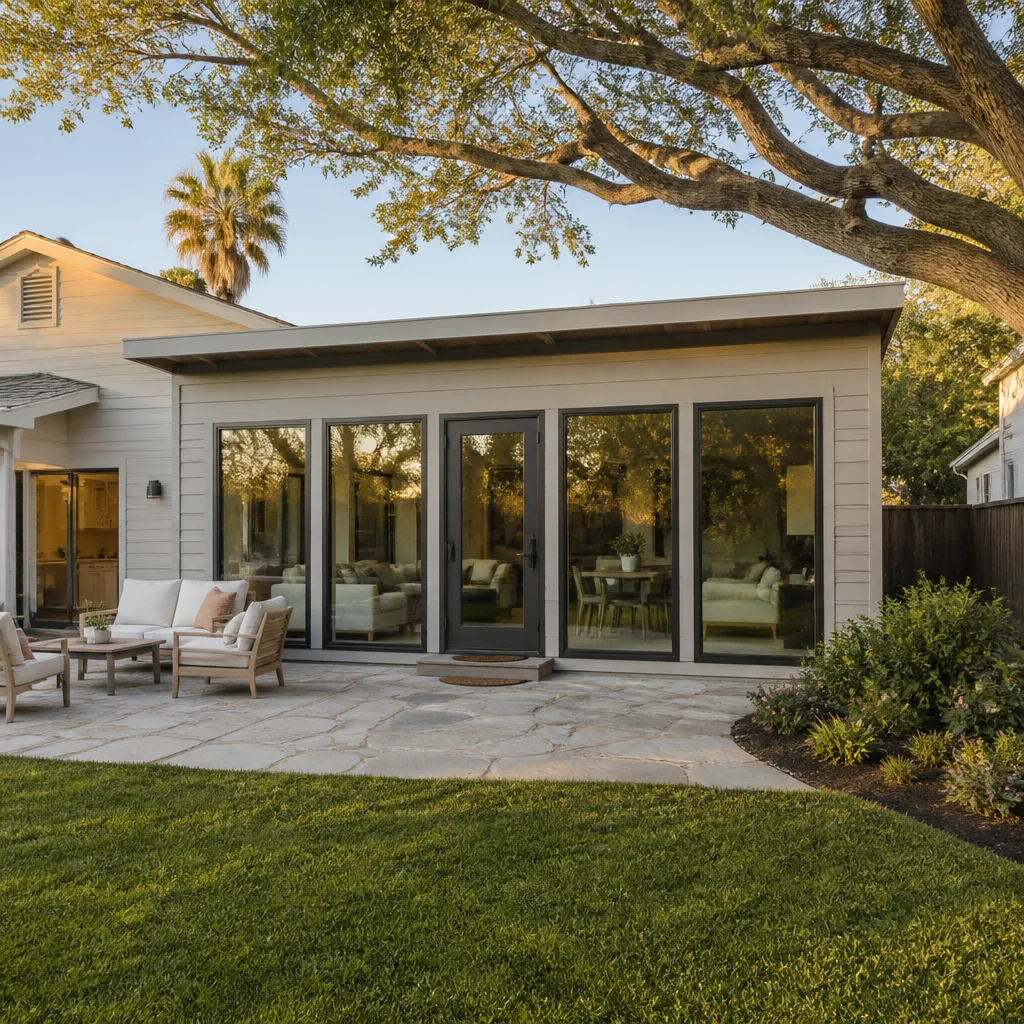
A full Mighty Buildings home addition or ADU in Houston runs $45,000 to $130,000 installed. That range covers the structural package, foundation or piers, rough mechanicals, interior finishes, and all required trade work. For repair or remediation of existing structures, the cost depends heavily on what failed. A panel seam reseal with proper flashing detail might run $2,000 to $8,000. A full panel replacement on a load-bearing wall can push past $20,000 depending on access and what has to be temporarily braced. You’ll get a written line-item price before any work starts, no exceptions. Our 365-Day Done Right Promise covers every completed scope in writing, and if something fails inside that year, we return and correct it at no charge.
What drives the range: number of panels, whether we’re doing foundation work, utility distance from the main house, finish level, and whether the existing structure needs demo or remediation first. We pull permits, we call inspections, and we don’t hand you a final invoice until the site is clean and the written guarantee is in your hand.
DIY or Call Us?
There are things you can safely check yourself: look for visible seam gaps, check for water staining after a hard rain, and note which doors bind. Those observations help us quote accurately. What you should not do is attempt to remove or recaulk structural panel joints yourself. These panels are load-bearing in most applications, and opening the wrong seam without temporary bracing can compromise the structure. The corner connection hardware is under tension in ways that aren’t obvious from the outside. If you suspect a panel has failed or a connection is compromised, that’s a structural question, not a caulk gun job.
If you’re seeing any of the symptoms above, call Bradford Remodeling Co Houston at (940) 289-7658. We’ll send a crew out, inspect the structure, and give you a written scope and number. Straight scope, straight number, that’s the whole conversation.
FAQs
The composite panels themselves are rated for decades, but the envelope details like sealants, flashings, and utility penetrations typically need inspection and occasional maintenance every 5 to 7 years in Houston’s heat and humidity. The structure should outlast the original finishes if the water management details were done right at installation.
Yes, in most cases we can repair seam failures, reflash transitions, and reinforce connection points without removing panels. Full panel replacement is only necessary when the panel itself is cracked, delaminated, or has absorbed enough moisture to compromise its structural rating. Call (940) 289-7658 and we’ll tell you which situation you’re in after an inspection.
A seam reseal or flashing repair is typically a 2 to 4 day job. A full addition or ADU runs 8 to 16 weeks depending on scope, permits, and utility work. We’ll put the timeline in the written estimate so you’re not waiting on a vague promise.
We keep common connection hardware, sealants, and flashing materials on hand. Structural panels and OEM-specific components are ordered per job, which adds lead time we’ll account for in your written estimate. We also stock compatible finish materials from KraftMaid, Cambria, and Silestone so the interior package isn’t waiting on a specialty order.
Written by Curtis Lane, Owner, Bradford Remodeling Co Houston at Bradford Remodeling Co Houston, serving Houston and nearby areas.


