

Last updated October 16, 2026







Free written scope consultation - allowances, timeline, and change-order rules on paper before a single trade is scheduled
Construction Warning Signs: A Houston Homeowner’s Reference Guide
The most expensive contractor red flag in Houston isn’t a missed appointment or a muddy boot print on your hallway carpet. It’s a contract clause that reads like boilerplate but functions like a blank check: cost-plus with no cap, a century-old billing structure that legally permits your general contractor to bill you for every subcontractor markup and materials fluctuation with no ceiling. This guide walks through the warning signs that actually cost Houston homeowners real money, most of them contractual, procedural, and deliberately shaped to look like standard industry practice. For a deeper look at making smart choices early in the process, see our How to Hire a Construction Contractor in Houston: A Step-by-Step Guide. By the time you finish, you’ll know which contract language to strike, what a legitimate deposit schedule looks like, and what to do if you’re already buried in a bad agreement.
Quick Answer
Contractor red flags in Houston divide into two categories: the obvious ones (no-shows, missing license, no insurance certificate) and the expensive ones (cost-plus contracts with no cap, deposits above 15%, arbitration-only dispute clauses, and lien waiver waivers). The red flags that cost Houston homeowners the most money are contractual and procedural, not behavioral. A legitimate residential remodeler should provide a written, fixed-price scope of work before any payment changes hands, cap any cost-plus arrangements in writing, and pull permits through the proper Houston and Harris County channels rather than asking you to pull them yourself. If you’re weighing whether to tackle work yourself or bring in a pro, our DIY vs Professional Construction: The Houston Homeowner’s Decision Guide can help you decide where the line sits for your project.
Styles & brands we work with







Table of Contents
- Contract Language That Should Stop You Cold
- The Deposit Structure Warning Sign
- Subcontractor Warning Signs on the Job Site
- When a Contractor Is Working Above Their Licensed Scope
- What to Do When You’re Already in a Bad Contract
- Houston-Specific Warning Signs: Climate, Code, and Market
- Common Mistakes to Avoid
- When to Call a Professional
Contract Language That Should Stop You Cold
The difference between a remodel that runs over budget by 4% and one that runs over by 40% is often decided by three paragraphs in a contract most homeowners skim. These clauses are legal, enforceable, and written by lawyers who understand exactly how much money they protect. Here is what each one means in plain terms.
Cost-plus with no cap. In a cost-plus contract, you agree to pay the contractor’s actual costs plus a percentage markup, typically 10% to 20%. There is nothing wrong with cost-plus as a structure for certain jobs, especially when the scope is uncertain, as with a home with hidden water damage or a kitchen where load-bearing walls may hide surprises. The problem is the absence of a guaranteed maximum price, often called a GMP. Without a cap in writing, every subcontractor invoice, every lumber price bump, and every backordered fixture carries your liability. In Houston, where lumber and drywall prices have swung hard since 2020, an uncapped cost-plus contract on a Kitchen Remodeling in Houston project can turn a $45,000 estimate into a $70,000 final invoice, legally. Before you sign, ask the contractor to put a guaranteed maximum price in writing. If they refuse, treat that refusal as a warning sign, not a negotiation tactic.
Arbitration-only dispute clauses. Many Houston remodeling contracts include a clause requiring that any dispute go through binding arbitration rather than court. Arbitration is not inherently bad; it can be faster and cheaper than litigation. But an arbitration-only clause sometimes also waives your right to participate in a class action, limits discovery, and requires you to split arbitrator fees that can run several thousand dollars before a single argument is heard. More importantly, some contractors use arbitration clauses because they know most homeowners won’t bother pursuing a $12,000 dispute through a private arbitration process. Read the dispute resolution language carefully. If the contract requires arbitration administered by a specific, expensive provider and bars you from small claims court, that is a red flag worth discussing with a construction attorney before you sign.
Lien waiver waivers. A lien waiver is a document signed by a subcontractor or supplier confirming they have been paid for work performed and waiving their right to file a mechanic’s lien against your property. These waivers protect you. A lien waiver waiver is something else entirely: a clause in your contract that attempts to strip away your right to demand those waivers from subs and suppliers. In Texas, subcontractors and suppliers have constitutional lien rights against your property even if you paid your general contractor in full. If your GC fails to pay the electrical sub, that sub can lien your house, and you may have to pay twice. What protects you is a contract that requires the GC to provide lien waivers from every sub and supplier before each draw payment. If the contract includes language waiving your right to those lien waivers, strike it. In our experience on General Contractor in Houston projects, the absence of a lien waiver requirement is one of the most reliable predictors of a future payment dispute.
The Garrison Standard exists for exactly this reason. Every price, every scope line, and every guarantee goes into writing before a single tool comes out. There is no pricing model that hides behind someone else’s invoice.
The Deposit Structure Warning Sign
A legitimate residential general contractor in Houston rarely needs more than 10% to 15% of the total contract value as an initial deposit. That number covers mobilization, early materials ordering, and permit application fees. When a contractor asks for 30%, 40%, or 50% upfront, the question you should ask is not “Can I negotiate this down?” but “Why is this company’s cash flow my problem?” Our General Contractor Maintenance Checklist for Houston Homeowners covers what healthy contractor financial practices look like from start to finish.
Here is what different deposit requests typically signal:
- 10% to 15% upfront: Standard for well-capitalized remodeling contractors. This covers the cost of pulling permits, scheduling crews, and ordering materials with long lead times. It signals a business that does not need your project’s cash to finish someone else’s project.
- 20% to 25% upfront: Common on smaller jobs under $15,000, but worth a second look on larger projects. Ask what specific costs the deposit covers. If the answer is vague, get it in writing.
- 30% to 40% upfront: A warning sign. At this level, the contractor may be using your deposit to pay off debt from a previous job, cover payroll, or fund marketing. In Houston, where remodeling demand has stayed strong since the post-Harvey rebuild wave, a contractor asking for 40% upfront on a standard remodel is telling you something about their balance sheet.
- 50% or more upfront: Walk away. No established contractor doing Home Remodeling in Houston work needs half the project value just to start.
Beyond the initial deposit, the draw schedule matters just as much. Payments should be tied to completed milestones: rough-in inspection passed, drywall hung, cabinets delivered, final walkthrough complete. Never agree to a payment schedule based on calendar dates rather than work milestones. A contract that says “25% on day 1, 25% on day 15, 25% on day 30” regardless of whether any work has happened is a financing structure for the contractor, not a construction schedule for you.
The one exception to the deposit rule is custom-ordered materials. If you’re installing Wellborn cabinetry or a Cambria or Silestone countertop, those products are manufactured to your job’s specifications and cannot be returned. A contractor may legitimately ask you to cover the full cost of those materials at the time of order. That’s not a deposit; that’s you buying your own materials. The distinction is that the invoice should come from the supplier or be passed through to you at cost, not marked up as part of the contractor’s general deposit.
Subcontractor Warning Signs on the Job Site
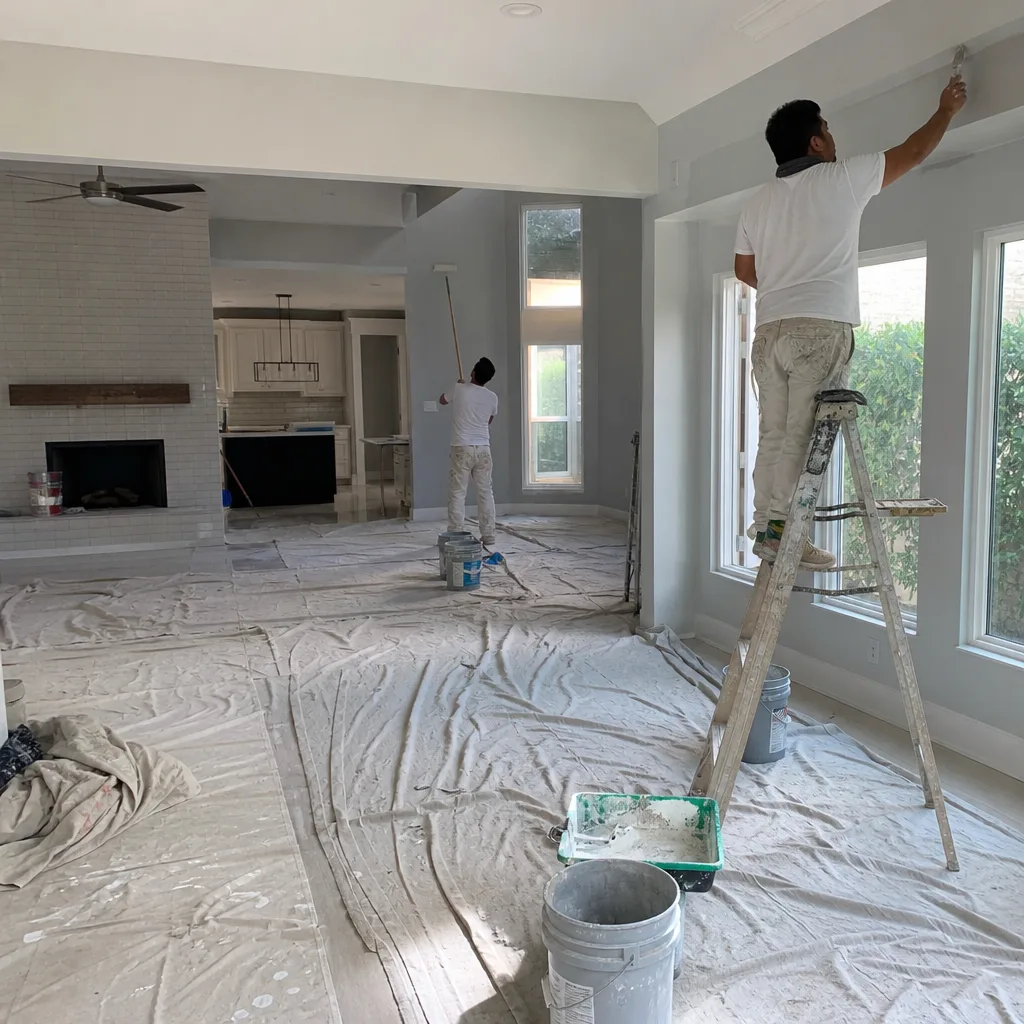
Most Houston homeowners never meet the people who actually build their remodel. General contractors subcontract out most of the physical work: framing, electrical, plumbing, drywall, tile, paint. There is nothing wrong with that. The warning signs appear when the relationship between the GC and the subs is loose, undocumented, or deliberately obscured.
Here are the job site signals that should make you ask questions:
- Unmarked vans and trucks. Legitimate trade companies in Houston almost always run marked vehicles. A tile contractor with a magnetic logo on the door has a phone number you can call if something goes wrong. A crew arriving in unmarked personal vehicles may be unlicensed labor, paid in cash, with no insurance and no company identity behind them. One unmarked van on a job site can be a legitimate owner-operator. Three or four of them suggests the GC is assembling day labor rather than running a documented project.
- Workers who can’t name the general contractor. Walk onto your job site and ask a worker, “Who are you working for?” If the answer is a shrug, a first name only, or the name of a sub you’ve never met, your GC does not have a controlled job site. Every worker on a Bradford Remodeling Co Houston job knows the company name, because every crew member is background-checked and uniformed before they ever walk through your door. That standard is set at the Garrison Partners level and applied to every site, not left to individual job foremen.
- Materials that don’t match the approved spec sheet. Your contract specifies Caesarstone for the countertops, but the slab that arrives has a different brand’s label. Your contract specifies a certain grade of plywood for the subfloor, but the stack in the garage is a different thickness. Any substitution should be documented, approved by you in writing, and reflected in the price. If the sub says “the GC told me to pick up whatever was available,” that’s a red flag that the materials budget is being managed informally, and you are paying for the informality.
- Cash payments changing hands on site. If you see your general contractor paying a sub in cash from a truck window, that sub is probably not on the books. No invoice, no lien waiver, no paper trail. In Texas, that means you have no protection if the sub later claims they weren’t paid and files a lien against your property.
- A rotating cast of crews. Some turnover is normal. But if you have three different drywall crews in three weeks, the GC is likely cycling through the cheapest available labor rather than managing a consistent trade partner. Quality control suffers, and so does your warranty.
When we run a project, the site is squared away at every stage: documented scope, traceable materials, and a written guarantee in the homeowner’s hand at close. That’s what discipline looks like, and it’s what you should demand from any contractor in Houston.
When a Contractor Is Working Above Their Licensed Scope
Texas does not license general contractors at the state level. That surprises a lot of Houston homeowners, because it means any person with a truck and a business card can legally call themselves a general contractor and take on a residential remodel. What Texas does license, through the Texas Department of Licensing and Regulation (TDLR), are the specific trades: electrical, plumbing, and HVAC. Those licenses matter, and they matter to you even if you never meet the licensed tradesperson.
Here is how to spot a contractor operating above their licensed scope:
- Electrical work. In Texas, any electrical work on your home must be performed by a licensed electrician or a registered apprentice working under a licensed electrician’s supervision. If your general contractor says their carpenter will “handle the wiring,” that’s a scope violation. Ask to see the TDLR license number of the electrician on your job. If the GC can’t produce it, the work is unlicensed.
- Plumbing work. Same standard as electrical. A plumber holding a TDLR license must perform or directly supervise all plumbing work. A GC who says “we’ll just move that sink over, no need for a plumber” is asking you to accept unpermitted, unlicensed work that can fail inspection and void your homeowner’s insurance if it leaks.
- HVAC work. Moving ductwork, installing new lines, replacing an air handler: all of it requires a licensed HVAC contractor. Houston’s climate makes this especially relevant, because improperly installed HVAC in a humid climate leads to mold, and mold remediation runs into the tens of thousands of dollars.
- Structural work. Texas does not license structural engineers, but the City of Houston requires permits and engineering sign-off for any work involving load-bearing walls, foundation modification, or roof structural changes. If your GC says “we don’t need a permit for this,” on a project that involves moving a wall, check with the Houston Permitting Center before you proceed. An unpermitted structural change can derail a future home sale.
The practical rule: your general contractor’s license, insurance, and reputation matter, but so does the licensing of every trade underneath them. A disciplined GC keeps a documented roster of licensed subs and can produce their license numbers on request. If the answer is “don’t worry about it,” that’s the moment to start worrying.
What to Do When You’re Already in a Bad Contract
If you’re reading this while already under contract with a contractor who is demanding money upfront, refusing lien waivers, or doing work without permits, you have options. None of them are pleasant, but all of them beat writing checks and hoping for the best.
- Stop the work. In writing. Send the contractor a written notice that you are suspending the project pending resolution of the specific issues you’ve identified. Texas law does not require you to let a contractor keep working while you dispute the terms. Document everything: photos, emails, text messages, invoices. In Harris County, that paper trail is your first line of defense if the dispute escalates.
- Understand the Texas Right to Repair Act. The Texas Residential Construction Liability Act, commonly called the Right to Repair Act, applies to residential construction defect claims. Before you can sue a contractor for defective work, you generally must give them written notice of the defect and a reasonable opportunity to repair it. The process has specific timelines and formatting requirements. If you’re heading toward litigation, consult a construction attorney who practices in Houston and understands the Houston courts. Do not attempt to navigate this process with a form letter from the internet.
- Know your mechanic’s lien exposure. Under Texas law, subcontractors and suppliers who are not paid can file a mechanic’s lien against your property, even if you paid your GC in full. The lien is attached to the property itself, not to the contractor, which means it can block a sale or refinance. Your protection is the lien waiver process: before you release any payment, demand lien waivers from every sub and supplier who has been on the job. If your contract does not give you that right, you can still request the waivers directly; most subs will provide them because it’s standard practice in Houston construction.
- Know when to involve the TDLR or TREC. If the contractor held themselves out as licensed in a trade they are not licensed in, file a complaint with the Texas Department of Licensing and Regulation. That applies to electrical, plumbing, and HVAC work. If your contractor is also a licensed real estate professional, the Texas Real Estate Commission (TREC) has jurisdiction over their conduct. The City of Houston’s Permitting Center can also tell you whether permits were ever pulled for your project, and what to do if the answer is no.
- Consult before you sign anything else. Contractors often respond to disputes by producing a “change order” or a “revised scope” document that, on close reading, asks you to waive claims you didn’t know you had. Before signing any new document from a contractor you’re already in a dispute with, have it reviewed by an attorney. An hour of review costs a few hundred dollars. A bad litigation position costs tens of thousands.
At Bradford Remodeling Co Houston, we put everything in writing precisely so this situation never happens. Written price before work starts, no exceptions. A 365-Day Done Right Promise on every completed project. If the work fails inside that window, we come back and correct it at no charge. That’s not a marketing line. It’s a signed guarantee, and it’s the only kind of contractor relationship worth having in Houston.
Houston-Specific Warning Signs: Climate, Code, and Market
Houston is not a neutral construction market. The climate is humid subtropical, which means the way a contractor handles moisture, ventilation, and materials matters more here than it does in Dallas or Austin. The city’s permitting process runs through the Houston Permitting Center, and the market has been shaped by decades of storm-driven demand, which has attracted both excellent contractors and a steady supply of opportunists.
Here are the warning signs specific to Houston:
Moisture management shortcuts. Houston’s average relative humidity stays above 70% for most of the year. A contractor who frames a bathroom or kitchen without proper vapor barriers, or who installs drywall over damp framing, is building mold into your walls. In our experience, we regularly see remodel failures in Houston that trace back to one thing: the contractor rushed the substrate. The substrate is the layer beneath the surface, the framing and sheathing and underlayment that everything visible is attached to. If it’s wet, warped, or improperly installed, no amount of expensive tile or paint will save the finished surface. Ask your contractor how they handle moisture during framing and rough-in. If the answer is vague, that’s a Houston-specific red flag.
Unpermitted post-storm work. After every major storm, Houston sees an influx of out-of-town contractors chasing insurance payouts. Some are legitimate. Some are not. The warning sign to watch for: a contractor who offers to handle your “insurance claim” while also asking you to skip permits “to save time.” Any contractor offering to do unpermitted structural, electrical, or plumbing work in Houston is asking you to assume liability for their shortcuts.
Foundation casualness. Houston sits on expansive clay soils that shift with moisture levels, which is why foundation issues are more common here than almost anywhere else in the country. A contractor who dismisses a visible crack as “just settling” without recommending an engineer’s assessment is not doing you a favor. In Houston, foundation movement is a structural question, not a cosmetic one.
Flood zone awareness. Large portions of Houston sit in mapped flood zones. Any remodel that touches the first floor of a home in a flood zone should account for flood-resistant materials and elevation considerations where applicable. If your contractor doesn’t mention flood zones at all during a first-floor remodel in neighborhoods like Meyerland, Kingwood, or the areas around Brays Bayou, they’re not paying attention to the specific conditions of your property.
The disciplined approach looks different. A contractor who works in Houston regularly knows which neighborhoods have clay soil issues, which permit office moves quickly and which ones don’t, and which materials hold up in 90% humidity. That local knowledge is part of what you’re paying for, and it’s part of the Garrison Standard: no generic national playbook, just the straight trade talk that applies to your specific house on your specific street.
Common Mistakes to Avoid
- Signing a contract you haven’t read line by line. Most Houston homeowners spend more time reading a restaurant menu than their remodeling contract. The clauses that cost you money are buried in the middle, in plain English, waiting for you to skim past them. Read every line. If you don’t understand a clause, ask. If the answer doesn’t satisfy you, walk.
- Accepting verbal change orders. “We’ll just add that to the final invoice” is how a $2,000 change becomes a $6,000 surprise. Every change order should be in writing, priced, and signed before the work happens. In Texas, verbal change orders are enforceable under certain circumstances, which is exactly why you should never agree to one.
- Paying in cash with no receipt. Cash payments are untraceable. A contractor who asks for cash is either avoiding taxes, avoiding liability, or avoiding a paper trail. All three of those avoidances work against you. Pay by check, card, or wire, and keep every receipt. In Harris County, that paper trail is what protects you in a dispute.
- Assuming the contract protects you because it looks official. A 30-page contract is not automatically comprehensive. Often, it’s a wall of boilerplate designed to look authoritative while containing the exact clauses described above: cost-plus with no cap, arbitration-only, lien waiver waivers. Length is not the same as protection.
- Ignoring the permit question until it’s too late. Permits are not an add-on. They’re the legal record that your work was inspected and approved. In Houston, unpermitted work can complicate a future sale, invalidate insurance claims, and in some cases require demolition to bring the work into compliance. If your contractor says “we never pull permits for this kind of job,” find a different contractor.
- Hiring based on lowest bid without comparing scope. Three bids for the same kitchen remodel in Houston can legitimately range from $38,000 to $75,000, and the cheapest one is not always the rip-off. But when one bid is dramatically lower, the reason is usually scope, not efficiency. Cheaper materials, no permit costs, no insurance, no lien waivers, no warranty. Compare the bids line by line, not just the final number.
- Letting the job site become a storage unit. A contractor who leaves materials, debris, and half-finished work scattered across your property for weeks is signaling a lack of control. In Houston’s climate, exposed building materials absorb humidity, which degrades the substrate before it’s even installed. A squared-away site is not just about tidiness; it’s about material integrity.
When to Call a Professional
Some warning signs are serious enough that the only right move is to stop the project and bring in professional help. If you’ve discovered unpermitted structural, electrical, or plumbing work; if a contractor is demanding payment beyond the agreed schedule; if a lien has been filed against your property; or if you’ve caught a contractor substituting materials without approval, do not try to untangle it alone. Get a construction attorney, a licensed inspector, and in cases involving electrical or plumbing, the TDLR involved.
If you’re still in the planning phase and want to avoid these situations entirely, the standard is simple: a written, fixed-price scope of work, a documented sub and material list, and a written guarantee that survives the final walkthrough. Bradford Remodeling Co Houston offers free estimates to Houston homeowners and will put the entire price in writing before any work begins. Call (940) 289-7658 to schedule yours. You can also learn more about how we operate on our Bradford Remodeling Co Houston home page.
See the difference
 Before
 After
After Before
 After
After Before
 After
AfterFrequently Asked Questions

The biggest red flag is a cost-plus contract with no guaranteed maximum price, which legally allows the contractor to bill you for every cost overrun and leaves you with no written ceiling on the final invoice. Any legitimate Houston remodeler should be willing to put a cap in writing. If they won’t, that tells you how they expect the project to go. Call (940) 289-7658 if you want to see what a written, fixed-price scope looks like.
A legitimate residential contractor in Houston should ask for no more than 10% to 15% of the total contract value as an initial deposit, with the exception of custom-ordered materials like Wellborn cabinetry or Cambria and Caesarstone countertops, which you may be asked to pay for in full at the time of order. Any deposit demand above 25% on a standard remodel is a warning sign that the contractor is using your money to fund other obligations.
A lien waiver protects you from having a subcontractor or supplier file a mechanic’s lien against your home if your general contractor fails to pay them. In Texas, subs and suppliers can lien your property even if you paid your GC in full, so lien waivers are your primary protection. Demand them from every sub before every payment release.
No. Texas does not license general contractors at the state level, which means anyone can call themselves a GC. What Texas does license, through the TDLR, are electricians, plumbers, and HVAC technicians. Always verify that the specific trade professionals on your job hold active TDLR licenses, regardless of what the GC claims.
First, stop the work and contact the Houston Permitting Center to understand what permits should have been pulled. Then, consult a construction attorney about your options under the Texas Right to Repair Act and any potential liability you’ve assumed. Unpermitted work can complicate insurance claims and future home sales, so address it sooner rather than later.
A fair remodeling contract includes a written, fixed-price scope of work; a payment schedule tied to completed milestones rather than calendar dates; a lien waiver requirement for all subs and suppliers; a dispute resolution clause you understand; and a written warranty that survives the final walkthrough. If any of those elements is missing, ask for it in writing before you sign. The Garrison Standard exists because a fair contract should never be a negotiation victory; it should be the baseline. Call (940) 289-7658 for a free estimate and see what that looks like in practice.
The Bottom Line
The contractor red flags that cost Houston homeowners real money are rarely dramatic. They’re contract clauses, deposit structures, and procedural shortcuts designed to look unremarkable. A cost-plus contract with no cap is a blank check. A 40% deposit demand is a financing request, not a construction necessity. A sub who can’t name the GC is a lien waiting to happen. The defense is not suspicion, it’s paper: written scopes, written caps, written lien waivers, and a written guarantee. For more guides & resources on protecting your investment, explore our blog. Bradford Remodeling Co Houston operates on exactly that standard. Written price before work starts. 365-Day Done Right Promise on every project. Live-person phone coverage around the clock. Call (940) 289-7658 for a free estimate, and get the discipline in writing.
Written by Curtis Lane, Owner at Bradford Remodeling Co Houston, serving Houston since 2004.


