
Free written scope consultation - allowances, timeline, and change-order rules on paper before a single trade is scheduled
Cambridge Pavers Home Additions & ADU: The Houston Owner’s Guide
Cambridge Pavers home additions and ADU projects in Houston typically run $45,000 to $130,000 for a full addition, and $90,000 to $220,000 for a detached ADU built to code. We install and build with Cambridge Pavers products as part of larger remodeling scopes, and most paver-to-structure tie-in work (thresholds, walkway transitions, drainage integration) can be quoted within one week of a site visit. If you’re landing here because a Cambridge paver walkway, patio edge, or step is failing where it meets an addition or ADU foundation, the cause is usually one of three things: Houston clay soil shifting under the paver base, improper drainage pitch away from the new structure, or a sub-base that wasn’t compacted in lifts before the pavers went down.
We’re an independent Houston remodeling contractor, not a Cambridge Pavers dealer or affiliate. What we do is match your existing Cambridge Pavers profile and color to new work, and we stand behind it with the 365-Day Done Right Promise. If the tie-in fails within a year, we come back and correct it at no charge.
Which Cambridge Pavers Models This Applies To
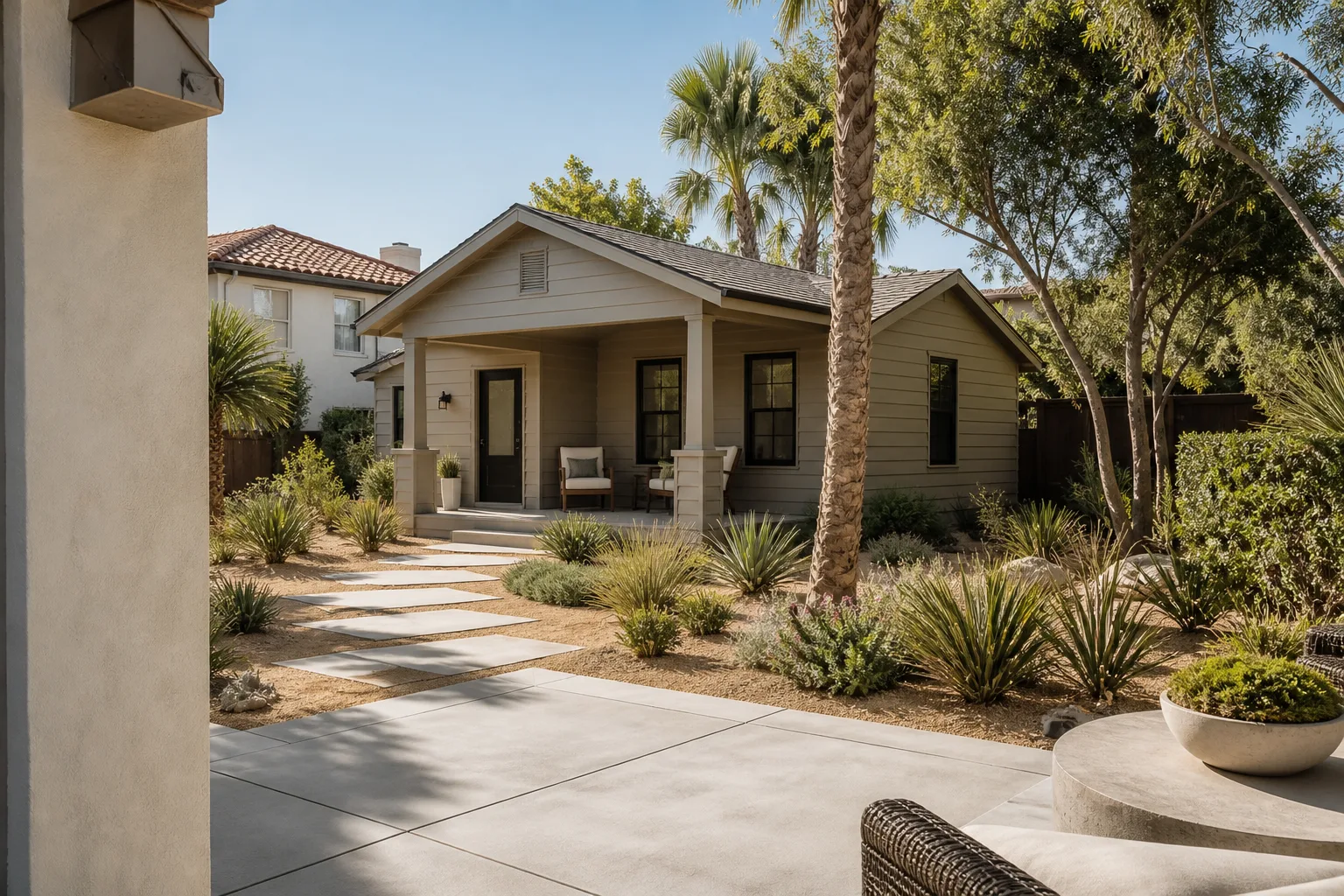
Cambridge Pavers runs three product families that matter for Houston additions and ADUs: the Ledgestone line (textured, irregular edges, common on patios), the RoundTable line (tumbled, softer edges, popular for pool decks and walkways), and the Sherwood line (clean, modular rectangles used for driveways and larger surfaces). Each has a distinct joint width and thickness spec. Ledgestone runs 60mm thick with a wider 1/4″ to 3/8″ joint. RoundTable is typically 60mm as well but with a tighter joint. Sherwood comes in 60mm and 80mm for driveway-rated loads.
The compatibility gotcha most Houston homeowners miss: you cannot mix paver thicknesses on a single load-bearing surface. If your existing patio is 60mm Ledgestone and the addition calls for an 80mm paver at the threshold, the height differential will either trip someone or pool water. We cut and shim to match the existing elevation, or we pull back enough of the old surface to make the transition clean. Before any quote, we check the stamp on the back of one paver. The mold number tells us the exact profile and color lot. Without that, a visual match is a guess.
For OEM versus aftermarket: Cambridge Pavers are manufactured in New Jersey. Houston supply houses stock a limited range, and color lots shift between production runs. When we add to an existing Cambridge surface, we prefer to source from the same local distributor that supplied the original job if the homeowner has the paperwork. If not, we order samples and match in daylight, not under a showroom lamp. Aftermarket equivalents exist from Belgard and Unilock, but the color tone and edge profile are rarely a true match. For a small patch, OEM is the only route that won’t look like a scar.
Styles & brands we work with







Signs Your Cambridge Pavers Home Additions & ADU Is Failing
- Water pooling at the addition threshold after a Houston rain. The paver base has settled or the pitch was never cut away from the structure. Water sitting against a foundation here means pier and beam or slab movement within two seasons. This is the most common failure we see in the Heights and Garden Oaks, where the clay is gumbo and the flat lots give water nowhere to go.
- Pavers rocking or sounding hollow underfoot. The bedding sand has washed out through the joints, usually because polymeric sand was never installed or the edge restraint failed. One loose paver becomes ten within a month.
- Visible separation between the paver surface and the addition’s foundation or skirting. Houston’s freeze-thaw cycle is mild, but our wet-dry cycle is brutal. Clay expands when wet, contracts when dry. That movement opens a gap, and the gap lets water in, which makes the movement worse.
- Efflorescence or white crust blooming across the surface near the new structure. Water is trapped under the pavers and wicking minerals up. It’s cosmetic at first, but it tells you the drainage layer isn’t doing its job.
- Step or stair riser shifting off its base. If a Cambridge step unit was laid on an un-compacted base at the ADU entrance, the riser will start to lean. This is a tripping hazard and a water entry point, and in Houston’s heavy storms, it becomes a gutter straight into the structure.
See the difference
 Before
 After
After Before
 After
After Before
 After
AfterReplacement Cost & What’s Included
Here’s what a Cambridge Pavers tie-in, extension, or repair around a Houston home addition or ADU actually costs, based on the projects we scope:
- Paver patio extension off a new addition: $3,500 to $11,000, depending on square footage, base depth, and whether we’re matching an existing Cambridge pattern.
- Threshold repair where pavers meet a foundation: $1,200 to $4,000, including pulling back the affected area, re-compacting the base, setting the edge restraint, and re-laying with fresh polymeric sand.
- Full paver walkway replacement from house to ADU: $4,500 to $9,000, including base excavation, geotextile fabric, compacted aggregate, and Cambridge Pavers matched to your existing color lot.
- Driveway extension or replacement using Cambridge Sherwood 80mm: $7,000 to $18,000, with thicker base and heavier edge restraint rated for vehicle load.
Every one of those numbers includes the written scope, materials, labor, haul-away, and the 365-Day Done Right Promise. The price you get in writing before we start is the price on the final invoice. No change orders, no re-pricing at the door. What drives the range is square footage, base condition, access for equipment, and whether the color lot is in stock locally or must be ordered from the distributor.
DIY or Call Us?
There’s a safe middle ground here. You can absolutely check the extent of the problem: walk the surface, mark every paver that rocks, note where water sits after a rain, and take photos of the mold stamps on the back of any loose pavers. That information helps us quote the job accurately over the phone.
What you shouldn’t do is pull pavers and start re-compacting a base yourself. Proper paver work around a structure isn’t just leveling sand. It’s getting the pitch right so water moves away from your foundation, setting edge restraint so the field doesn’t creep, and re-establishing the drainage layer under the base. Get that wrong under a Houston downpour and you’ve directed water into your addition or ADU foundation instead of away from it. Trenching near a slab edge also risks hitting plumbing or electrical runs that are only a few inches down. If the failure is at the threshold, call us at (940) 289-7658. The site visit and written quote are free, and we’ll tell you straight if the fix is a one-day repair or a full re-lay.
FAQs
With a properly compacted base and sealed polymeric joints, expect 20 to 30 years from the pavers themselves. What fails first in Houston is almost never the paver. It’s the base underneath, because our clay soil moves hard between wet and dry seasons. If you’re getting rocking or separation at year five or six, that’s a base-prep issue, not a paver defect.
Localized settling can be repaired in most cases. We pull the affected area, re-compact the base, re-set the pavers, and re-sand the joints. If the failure covers more than 30% of the surface or the base was never installed correctly, a full re-lay is the honest fix. We’ll tell you which one applies before you pay for anything. Call (940) 289-7658 and we’ll look at it.
A threshold repair or small patch is typically one day. A walkway replacement or patio extension runs two to four days depending on square footage and access. We’ll give you a written schedule with the written quote, and live-person phone coverage means you’re never chasing us for a status update.
We keep a limited stock of common Cambridge profiles on hand for threshold and step repairs, but full color-lot matching for additions and extensions is ordered from local Houston distributors. We also work with KraftMaid, Cambria, and Silestone on interior scopes, but for paver-to-structure work, Cambridge is matched through the same distributor network that supplies most of the Houston market. The lead time is usually 3 to 7 business days.
Straight scope, straight number – that’s the whole conversation. Call (940) 289-7658 for a free written estimate on your Cambridge Pavers addition or ADU tie-in.
Written by Curtis Lane, Owner, Bradford Remodeling Co Houston at Bradford Remodeling Co Houston, serving Houston and nearby areas.


