
Last updated October 16, 2026

Free written scope consultation - allowances, timeline, and change-order rules on paper before a single trade is scheduled
Construction Cost Breakdown: The Houston Homeowner’s Reference for 2026
Most national remodeling cost guides are built on RSMeans data that runs 12 to 18 months behind what Houston subcontractors actually charge. That lag means a homeowner budgeting from those averaged figures is 15 to 20 percent short before the first bid even lands on the table. This guide fixes that. We’re going to walk through real Houston labor rates by trade, show you how to read a line-item bid without getting taken, break down the soft costs that catch people off guard, and explain how fixed-price contracts protect you from material price swings in 2026. Houston’s market has its own pressures this year, and they matter more than any national average.
Styles & brands we work with







Quick Answer
A full-scale remodel in Houston in 2026 runs $95 to $285 per square foot depending on scope, with kitchens at $35,000 to $90,000, bathrooms at $18,000 to $45,000, and whole-home renovations at $150,000 to $400,000-plus. Three Houston-specific pressures are pushing those numbers: post-IRA demand for electricians, lumber tariff volatility, and a tight concrete subcontractor market. The single most effective way to control cost is a written fixed-price bid that specifies material allowances and escalation terms before work begins.
Table of Contents
- Houston Labor Rates by Trade in 2026
- How to Read a Line-Item Bid Without Getting Burned
- Material Categories Hit by Tariff Volatility
- Soft Costs: The 8 to 12 Percent You Did Not Budget For
- Fixed-Price Bids Versus Cost-Plus: Your Financial Exposure
- Houston Code, Climate, and What They Do to Cost
- Common Mistakes to Avoid
- When to Call a Professional
- Frequently Asked Questions
- The Bottom Line
Houston Labor Rates by Trade in 2026
Labor is the largest single line item in any Houston remodel, typically 40 to 55 percent of total project cost. What most guides will not tell you is that Houston has three distinct labor tiers, and they price differently. A union-rate electrician on a commercial-adjacent residential job in the Heights or Montrose may bill $95 to $130 per hour. A licensed independent running a two-man crew out of Spring or Katy typically charges $65 to $95 per hour. An unlicensed handyman crew will quote $35 to $55 per hour, and that savings usually shows up later in rework, failed inspections, and no warranty to call back on.
Here is what each major trade is actually billing in Houston right now:
- Framing/carpentry: $55 to $85 per hour for licensed crews; $8 to $14 per square foot for new framing on additions.
- Electrical: $75 to $115 per hour for a licensed journeyman plus apprentice. Demand from Inflation Reduction Act panel upgrades and EV charger installs has pushed this up 12 to 18 percent since 2024.
- Plumbing: $70 to $110 per hour. Rough-in for a full bath remodel in Houston runs $4,500 to $9,000 before fixtures.
- Tile setting: $45 to $70 per hour, or $8 to $15 per square foot for standard formats. Large-format and slab layouts run higher.
- Drywall and paint: $28 to $45 per hour, typically $1.50 to $3.25 per square foot finished, including texture matching.
- Concrete: $110 to $160 per cubic yard placed and finished for flatwork crew work, though the real pressure in 2026 is scheduling. Post-infrastructure-spending demand means a patio or driveway pour in Cypress or Sugar Land may wait three to five weeks for a crew.
The distinction between union-rate, licensed independent, and unlicensed pricing is not academic. Houston permits work from unlicensed contractors, and the city’s enforcement is lighter than most major metros. A General Contractor in Houston who runs on a documented labor roster can tell you which tier each trade on your job falls into and what that means for warranty risk. We will not put an unlicensed electrician on any Bradford job, period, because the liability lands on the homeowner when the panel inspection fails.
How to Read a Line-Item Bid Without Getting Burned
A legitimate bid is not a single number on a napkin. It is a scope document with labor, materials, and margin broken into categories you can actually interrogate. Here is the five-step method we teach homeowners:
- Look for the allowance list first. Anything labeled “allowance” is a placeholder, not a fixed price. A $25,000 kitchen bid with a $4,000 cabinet allowance means the contractor is pricing entry-level boxes and you will pay the difference when you choose better ones. The allowance number tells you what tier of material the contractor assumes you want. Ask for brand names, not categories.
- Separate pass-through from mark-up. Many line items are actual material or sub costs the GC passes through at cost plus a stated mark-up, typically 15 to 22 percent in Houston. Others are contractor per-hour labor. Knowing which is which tells you where negotiation room actually exists.
- Check for lump-sum line items. “Site prep” or “general conditions” without detail is where surprises live. Ask what it covers: dumpster rental, porta-potty, daily cleanup, protection of existing floors. If they cannot itemize it, they have not priced it.
- Compare labor hours, not just rates. A framing line at $8,500 may look cheaper than one at $9,200, but if the first assumes 80 hours at $106/hour and the second assumes 100 hours at $92/hour, the first bid will run over when the crew cannot hit 80 hours. Labor-hour assumptions matter more than hourly rate.
- Verify the change order language. The contract should state in writing how change orders are priced: same margin as the base bid, no hidden re-mobilization fees, and approved in writing before work proceeds. If it is silent, the contractor is telling you how the second half of the job gets priced.
Bradford’s approach, under The Garrison Standard, is simpler: every bid is a written fixed price before work starts. There is no second pricing conversation at the door. The scope, the material specifications, and the labor assumptions are in the document. When you sign it, the number is the number.
Material Categories Hit by Tariff Volatility
Three material categories have been moving in Houston since 2025, and they will continue to move through 2026. If your contract does not address them, you are carrying the risk.
Lumber. Tariff policy on Canadian softwood has not stabilized, and Houston builders know it. Dimensional lumber prices have swung 25 to 40 percent within single quarters. A framing package quoted in January may cost 18 percent more in June. The fix is a contract that locks lumber pricing with a dated quote from the supplier, or a written escalation clause that caps the pass-through at a stated percentage. Fixed-price contracts from Bradford include a dated material lock from our suppliers, not a floating number.
Copper wiring. Electrical rough-in material has become one of the least predictable line items in a Houston remodel. The reason is demand: IRA-driven panel upgrades, heat pump retrofits, and EV charger installations have soaked up residential electrical labor and material. Romex pricing has risen, and availability is tighter in high-growth corridors like Katy and Conroe. We specify wire gauge and panel requirements in the contract so the rough-in price is tied to a real scope, not an estimate.
Imported tile and stone. Tariff treatment on porcelain, ceramic, and natural stone from China, India, and Brazil has shifted repeatedly. A porcelain tile that cost $4.50 per square foot in early 2025 may be $6.10 now. The practical fix for Houston homeowners is to select tile during design and lock the price with the supplier at selection, not at installation. We write that into our process: material selections happen before contract signing, and the selected prices are the contract prices.
One more note: if a contractor gives you a bid with no escalation language and no material lock, they are either absorbing risk they have not priced for, or they plan to renegotiate mid-job. Neither is good for you.
Soft Costs: The 8 to 12 Percent You Did Not Budget For
Soft costs are the line items that never show up in a magazine remodel photo, and they typically run 8 to 12 percent of total project cost in Houston. They are real. They hit every job. And they are almost entirely predictable if someone tells you upfront.
- Permits and plan review: $800 to $3,500 for typical remodels. Houston permit fees are based on valuation, and plan review runs on top. Additions, structural changes, and panel upgrades trigger the most expensive permits.
- Engineering reports: $600 to $2,800 for load-bearing wall removal, foundation evaluation, or roof modification. A structural engineer’s stamp is mandatory for any wall that carries roof or floor load.
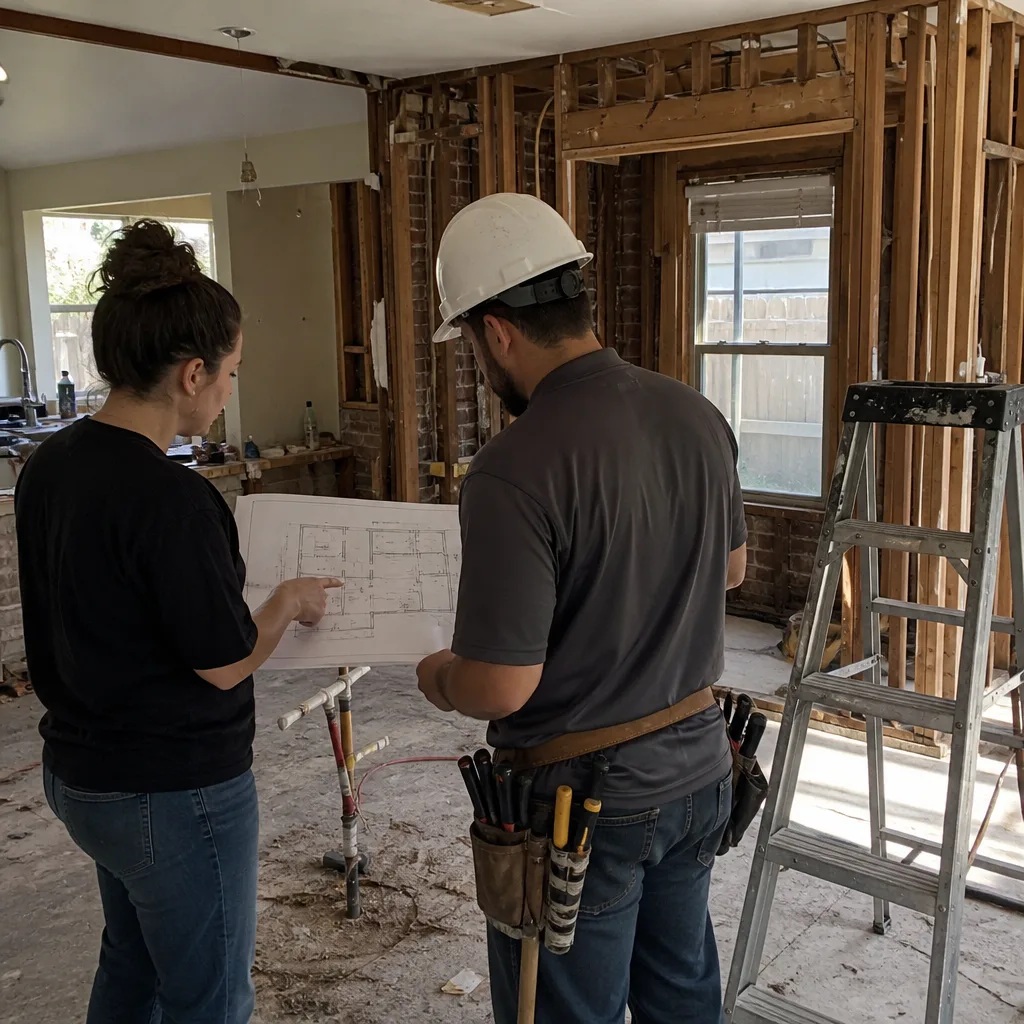
- Design and drawings: $1,500 to $8,000 for as-builts, demolition plans, and construction drawings. This is not a luxury; it is the document that keeps the permit review moving and the crew from guessing.
- Dumpster rental and debris removal: $400 to $900 per 20-yard dumpster, and a full kitchen demo plus flooring can fill one in a week. You will need two or three over the course of a whole-home job.
- Portable restroom: $150 to $250 per month. A crew of four working six weeks cannot use your bathroom. Budget for it.
- Utility locates and temporary power: $200 to $600. Call 811 before digging, and plan for temporary panel work if the electrical service is being relocated.
We include every one of these items in our written bids as a named line item. Nothing soft about it: if it will happen on the job, it gets a number. That is part of what Home Remodeling in Houston looks like under The Garrison Standard.
Fixed-Price Bids Versus Cost-Plus: Your Financial Exposure
There are two legitimate contract structures in Houston remodeling, and they expose you to completely different financial risks.
Fixed-price. The contractor quotes a total number for a defined scope, and that number holds unless you change the scope. Your exposure is limited to change orders you approve. The contractor carries the risk of their own estimating mistakes, material price movement within the contract terms, and labor overruns. Fixed-price works best for scopes that are well understood: kitchen remodels, bathroom remodels, additions with completed plans, and any job where the existing conditions are visible and the design is settled. Bradford runs exclusively fixed-price. The price is written before any work begins, and it does not move at the door.
Cost-plus. The contractor charges actual cost plus a stated percentage for overhead and profit. Your exposure is open-ended: if materials spike or the crew runs long, you pay the difference. The upside is transparency, and cost-plus can work for projects where the scope is genuinely unknowable, such as extreme foundation repair or water-damage remediation behind walls that cannot be opened until demo starts. The downside is that it incentivizes higher costs: the contractor’s fee rises with every dollar spent. If you go cost-plus in Houston, the contract must cap the fee, require written approval for any line over a stated threshold, and provide open-book access to invoices.
Most homeowners in Houston’s suburbs, from Pearland to The Woodlands, are better served by fixed-price. You are not hiring a contractor to learn on your dime. You are hiring someone to give you a number and hold it.
Houston Code, Climate, and What They Do to Cost
Houston’s climate is not a backdrop. It is a cost driver. The city sits in IECC climate zone 2A: hot, humid summers, mild winters, and enough moisture to destroy a bad deck ledger in three years. Any remodel that ignores moisture management is budgeting for failure. See our Construction Warning Signs: A Houston Homeowner’s Reference Guide for other red flags.
- Flashing and water management: Houston’s rainfall means window and door flashing must be done to manufacturer spec and taped at the rough opening. Cutting corners here shows up as rot behind siding within five years. Good flashing detail adds $300 to $800 per opening and it is worth every dollar.
- Ventilation and humidity: Bath fans, kitchen hoods, and crawlspace or attic ventilation matter more in Houston than in drier markets. A bathroom without a properly sized exhaust fan grows mold fast. Budget $250 to $600 per fan, plus ducting that actually vents to the exterior.
- Foundation awareness: Much of Houston sits on expansive clay soils. Remodels that change load paths, such as removing a wall, may require foundation evaluation before the engineer will stamp the plans. That is a $500 to $1,500 inspection that protects a $300,000 asset.
- Hurricane and wind requirements: Some Houston-area jurisdictions enforce wind-borne debris standards for windows and doors, particularly in new construction and major additions. Impact-rated windows run 30 to 60 percent more than standard glass. Worth knowing before you fall in love with a window line that will not pass code.
We have built in Houston long enough to expect the soil, the humidity, and the permitting office to have opinions. A competent contractor prices for the actual conditions, not the ones in a national cost book.
Common Mistakes to Avoid
- Budgeting from national averages. RSMeans data lags, and Houston’s specific pressures, from tariff-driven lumber swings to post-IRA electrical demand, push real subcontractor rates higher. Budget 15 to 20 percent above national averages, or start short.
- Signing a bid with vague allowances. “Cabinets: $5,000 allowance” is not a price. It is a starting point for an upsell. Ask for brand names, model ranges, and quantities in writing.
- Hiring unlicensed trades to save 20 percent. Houston allows it, but the risk lands on you: failed inspections, no warranty, and liability if something goes wrong. The savings rarely survives the rework.
- Ignoring soft costs. Permits, engineering, dumpsters, and temp facilities add 8 to 12 percent. Leaving them out means a mid-project “discovery” that blows the budget.
- Not asking about escalation language. In 2026, a contract that does not state how material price changes are handled is a contract that will be renegotiated mid-job.
- Picking the cheapest bid without comparing labor hours. A low number with unrealistically low labor hours is not a deal. It is an underestimate that becomes a change order.
- Signing without a written guarantee. Ask exactly what the warranty covers, for how long, and what happens if the work fails. If the answer is verbal, you do not have a warranty.
When to Call a Professional
Some jobs are honestly DIY-able: painting a bedroom, swapping a faucet, replacing a light fixture if the wiring is already there. The rest of what Houston homeowners face is not. Our DIY vs Professional Construction: The Houston Homeowner’s Decision Guide walks through how to tell the difference. If your project involves structural changes, electrical panel work, plumbing rough-in, or any alteration behind finished walls, get a professional involved before you open anything up. The cost of fixing a bad DIY load-bearing wall removal runs into five figures. The cost of a structural engineer’s opinion runs under a thousand.
If you are planning a remodel in Houston and want a written fixed price before any commitment, Bradford Remodeling Co Houston home offers free estimates. Call (940) 289-7658 and we will walk the job with you, line-item the scope, and put the number in writing.
Frequently Asked Questions
A mid-range kitchen remodel in Houston runs $35,000 to $65,000, with higher-end kitchens with custom cabinetry and stone surfaces reaching $70,000 to $90,000 or more. The biggest variables are cabinet construction, countertop material, and whether you are moving plumbing or electrical. Call (940) 289-7658 for a written line-item estimate specific to your kitchen.
A full bathroom remodel in Houston typically runs $18,000 to $45,000 depending on size, finish level, and whether the layout changes. Moving the toilet or shower drain adds plumbing rough-in cost and time. We provide written fixed pricing on Kitchen Remodeling in Houston and bath scopes before work begins.
Expect $95 to $285 per square foot in Houston for a full interior remodel in 2026. The low end assumes a cosmetic update in an existing layout, and the high end is a full gut with structural changes, new electrical and plumbing, and premium finishes. The square-foot figure is a planning tool, not a bid: actual pricing comes from a line-item scope.
On a Bradford fixed-price contract, the price changes only if you change the scope, and every change order is priced and approved in writing before work continues. The 365-Day Done Right Promise covers workmanship for a full year after completion. If the work fails inside that window, we come back and correct it at no charge.
Yes. Permits are part of the written scope, and we pull every required permit and schedule the inspections. The permit cost is a named line item in the bid, not a surprise. Unpermitted work in Houston can complicate resale, insurance, and lender requirements, and a competent contractor will not skip it.
Plan on 10 to 16 weeks for a full interior remodel of a 2,000-square-foot home, with kitchens at 6 to 10 weeks and bathrooms at 3 to 6 weeks. Houston’s permit review times and the tight concrete and electrical subcontractor schedules in 2026 add variability. A written schedule with milestone dates is part of The Garrison Standard scope document.
The Bottom Line
Houston remodeling costs in 2026 are not set by national averages. They are set by what electricians, framers, tilers, and concrete crews in this metro actually charge, what lumber and copper actually cost on the day you sign, and whether your contract puts the risk on you or on the contractor who did the estimating. The homeowners who get through a remodel without a surprise invoice are the ones who demanded a written line-item price, asked about allowances and escalation language, and confirmed the warranty in writing. That is the entire job. The rest is execution. For more guides & resources, visit our blog.
Written by Curtis Lane, Owner at Bradford Remodeling Co Houston, serving Houston since 2004.
Ready to get a written price for your Houston remodel? Call (940) 289-7658 to schedule your free estimate. No pressure, no vague allowances, no numbers that move at the door.
See the difference
 Before
 After
After Before
 After
After Before
 After
After

